A quieter woodworking workshop starts with the operation making the noise. Choosing a different process, maintaining equipment and reducing unnecessary vibration can be more useful than covering the walls with acoustic foam.
Quiet woodworking tools are only part of the solution. The workpiece, bench, dust extractor and building structure can all affect what you and your neighbors hear.
Start by identifying the loudest activities. Then address the source, the route sound takes through the building, and the people exposed to it.
Affiliate disclosure: This article contains affiliate links. If you purchase through these links, we may earn a commission at no extra cost to you.
Planning a more practical home workshop? Explore Ultimate Small Shop for space-planning ideas to evaluate alongside your noise-control needs.
Separate Hearing Protection From Neighbor Disturbance
Two different questions matter:
Is the sound exposure appropriate for the person working?
Is the activity disturbing other people?
A workshop can disturb someone upstairs even when the sound at that location is much lower than beside the tool. Conversely, neighbors may hear little while the operator experiences substantial noise.
Hearing protection addresses the wearer’s exposure. It does not make a machine quieter for everyone else.
Likewise, choosing an agreeable working time does not remove the need to control exposure inside the shop.
Our workshop noise and hearing protection guide covers personal protection separately. This article focuses on reducing the noise produced and transmitted.
Identify Which Activity Needs Attention
List the sounds people actually notice.
Examples include:
- A saw cutting material.
- A planer or router operating.
- A dust extractor running.
- A compressor starting.
- Mallet strikes transmitted through the floor.
- A bench or cabinet rattling.
- Long boards vibrating against a support.
The loudest tool is not always the only problem. A short cutting operation may be followed by several minutes of extraction noise, while repeated impacts can be especially noticeable in an adjoining room.
Make a simple record:
| Activity | What you notice | First question |
|---|---|---|
| Cutting | Noise increases when the blade enters the stock | Are the tool, blade and setup appropriate? |
| Extraction | Continuous sound throughout the session | Can the equipment or location be improved? |
| Mallet work | Thumps heard in another room | How is impact reaching the building? |
| Idle machine | Rattling or a new mechanical sound | Does the equipment need inspection? |
| Material handling | Boards strike floors or walls | Can storage and handling be improved? |
Stop and investigate an unfamiliar mechanical noise rather than treating it as something to cover with insulation.
Reduce Noisy Work Before Adding Equipment
The simplest improvement may be to avoid an operation at home.
Buying prepared lumber can reduce the need for thicknessing. Having panels cut by a suitable service can reduce repeated sawing. Preparing accurate parts elsewhere may leave fitting and assembly for the home workshop.
Check the quality and accuracy of any preparation service before designing around it. Rough breakdown cuts may still require further work.
For occasional tasks, access to a suitable community workshop may be more practical than trying to isolate a noisy machine inside a shared building.
This approach is particularly useful for apartment woodworking, where sound and vibration can affect several households.
Choose the Process Before the Tool
Compare methods that can produce the required result.
For a small adjustment, a suitable hand plane may avoid powering a machine. A hand saw may suit a few cuts. A screwdriver may be practical where repeated impact-driver use is unnecessary.
These are task-dependent choices. Hand tools still require skill, workholding and suitable material support.
They also create sound. Mallet-driven joinery can transmit noticeable impact noise, even without a motor.
A hand-tool workshop setup can reduce reliance on machines, but it should not be described as silent.
Our comparison of hand tools and power tools for small shops explains how to choose around your projects.
Compare Noise Information Carefully
When evaluating equipment, look for manufacturer noise information and the conditions under which it was measured.
Do not compare unlike figures. Sound power and sound pressure describe different quantities, and measurements may involve different distances, loads or operating conditions.
A figure measured while a tool runs without cutting may not represent its sound during your project.
Also consider the complete working system. A tool that needs an extractor should be assessed with extraction in mind.
Avoid assuming that a small machine, cordless tool or premium price guarantees quieter operation. Ask for relevant documentation rather than relying only on a “quiet” marketing description.
Maintain Tools and Accessories
Maintenance can prevent avoidable noise.
HSE’s review of woodworking noise controls identifies sharp, correctly aligned and balanced cutters as relevant to keeping cutting noise down. Follow the equipment manufacturer’s instructions for the specific tool and tooling.
Depending on the equipment, routine attention may include:
- Inspecting blades and cutters.
- Checking accessible fasteners.
- Maintaining belts and bearings as instructed.
- Keeping guards and covers correctly fitted.
- Removing debris that causes parts to rattle.
- Maintaining extraction equipment.
Disconnect or isolate equipment as instructed before inspection, adjustment or maintenance.
Do not alter guards, speeds or tooling arrangements simply to change the sound. Use compatible accessories and approved settings.
A worn or damaged component needs correction, not an acoustic cover.
Once the main noise sources are identified, review Ultimate Small Shop for workshop organization ideas that may help you position and access equipment more effectively.
Address Vibration Without Losing Stability
Sound can travel through the air, but vibration can also pass into benches, floors and walls.
Start by checking that the machine and its support are assembled and installed correctly. A loose panel or rocking stand can add noise that is not inherent to the cutting operation.
Suitable vibration isolation can help in some installations, but it must match the equipment, loads and mounting requirements.
Do not place a heavy machine on arbitrary pieces of soft foam. Excessive movement can affect stability and operation.
Similarly, changing a bench’s feet or supports can change how it behaves during planing, clamping or impact work.
Where vibration is reaching occupied rooms, seek advice appropriate to the equipment and building. This is especially relevant to a basement woodworking shop beneath living areas.
Understand Acoustic Treatment and Sound Isolation
Acoustic treatment and sound isolation solve different problems.
Sound-absorbing treatment reduces some reflected sound within a room. Its effectiveness depends on the material, coverage and sound frequencies involved.
Sound isolation aims to reduce sound transmitted into another space. Walls, ceilings, doors, gaps, penetrations and structural connections all matter.
Thin foam panels are not a complete soundproofing system. They may change how a room sounds without solving noise heard next door.
Before buying materials, identify whether the main problem is reflected sound, leakage through openings or vibration through the structure.
Use materials suitable for a workshop environment. Consider fire performance, durability and whether surfaces can be kept free of dust.
Be Careful With Machine Enclosures
A properly designed acoustic enclosure can reduce noise, but enclosing equipment changes more than its sound.
The design must account for:
- Cooling and ventilation.
- Dust collection airflow.
- Electrical access.
- Controls and emergency access.
- Maintenance.
- Manufacturer installation requirements.
Do not place a dust extractor or compressor inside an improvised sealed box.
Blocking airflow can interfere with operation, and an enclosure that makes maintenance difficult may create other problems. Use manufacturer-supported options or qualified design advice where appropriate.
Likewise, do not seal required building ventilation openings merely because sound passes through them.
Improve Placement and Work Habits
Positioning and scheduling can supplement source control.
Where practical, locate noisy equipment away from shared walls and rooms used for sleep or concentrated work. Keep benches and stored materials from unintentionally contacting surfaces that transmit vibration.
Avoid dropping boards, dragging equipment or leaving loose accessories to rattle during operation.
Prepare measurements and materials before starting a noisy task. This can reduce unnecessary running time and repeated restarts.
Agree on working hours with your household and follow applicable building rules. Group noisy operations when useful, but do not turn them into a prolonged session without considering operator exposure.
Scheduling makes work more predictable. It does not replace quieter methods or appropriate protection.
Check Whether the Change Helped
Evaluate improvements under comparable conditions.
Use the same operation, material and observation positions where practical. A comparison between an idling machine and one cutting stock tells you little about the effect of a modification.
Ask people in affected rooms whether the particular disturbance changed. Their feedback helps assess nuisance, but it does not establish safe exposure for the operator.
For exposure assessment or significant sound-isolation work, use suitable measurement equipment and qualified advice. Do not treat an unverified phone reading as proof that a workshop is safe or compliant.
Change one factor at a time so you can identify what actually helped.
Build a Practical Noise-Reduction Plan
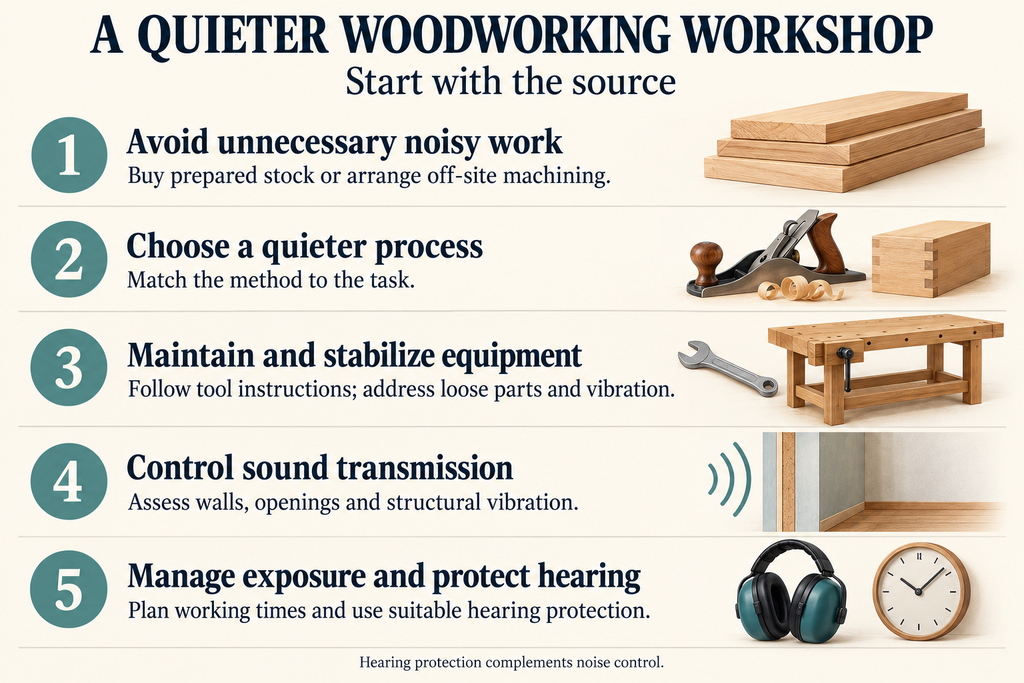
Start with the activity causing the greatest problem.
Consider whether it can be avoided, completed elsewhere or performed using a different method. Then address maintenance, installation and vibration. Evaluate room treatment or isolation where the remaining problem justifies it.
Keep hearing protection and working-hour arrangements as additional measures.
A quieter woodworking workshop comes from several compatible decisions. Focus on reducing noise where it begins, then address how it reaches the rest of the building.
Ready to improve your workshop plan? Explore Ultimate Small Shop and evaluate its layout ideas alongside your equipment instructions and noise-control priorities.