Table saw outfeed support helps carry a workpiece as it moves beyond the saw’s table. Infeed support helps manage material before it reaches the cutting area. Depending on the workpiece, support may also be needed beside the machine.
In a small workshop, these supports must fit both the operation and the available space. A folding table may store conveniently, while a broad stationary surface may better suit your regular projects.
Start with your equipment instructions and the material you intend to process. Choose support that remains stable, allows the required movement, and does not interfere with controls, guards, or your working position.
Affiliate disclosure: This article contains affiliate links. If you purchase through these links, we may earn a commission at no additional cost to you.
Planning tools and working space together? Explore Ultimate Small Shop as an additional workshop-planning resource.
What Are Infeed and Outfeed Supports?
For a table saw, the infeed side is where material approaches the blade. The outfeed side is where it travels after passing through the cutting area.
Support needs change as the workpiece moves.
A long board that rests securely at the beginning may become unbalanced near the end. A wide panel may also need lateral support to remain manageable.
| Support position | Purpose | What to assess |
|---|---|---|
| Infeed | Supports material approaching the tool | Starting position, handling, and operator access |
| Outfeed | Supports material leaving the tool | Transition from the machine and continued support |
| Side | Supports material extending laterally | Panel width, stability, and clearance |
Supports carry material. They do not replace the fence, guards, push devices, or operating technique required for the cut.
Before choosing supports, establish the machine’s position using our table saw placement guide.
Start With the Workpiece and Operation
List the materials you regularly process.
For each, record its approximate length, width, weight, and the operation you intend to perform. Include the size of both the finished part and the material removed during cutting.
A narrow roller stand may suit some long-board operations but provide too little lateral support for a broad panel. A large table may offer more support while occupying space needed for other work.
Ask:
- Where does the material need support at the beginning?
- How does its balance change during movement?
- Will the leading edge meet the support smoothly?
- Can the support interfere with a jig or accessory?
- Can I maintain the required working position?
DEWALT’s table saw instructions emphasize matching support to the workpiece’s size and the operation. Unsupported long material can shift and cause loss of control.
Compare the Main Support Options
| Support type | Potential advantage | Main limitation to check |
|---|---|---|
| Fixed outfeed table | Broad, consistently available support | Permanent floor-space commitment |
| Folding outfeed table | Packs away when not needed | Compatibility, deployment, and locking |
| Adjustable roller stand | Compact and easy to reposition | Alignment, stability, and limited contact area |
| Roller table | Several contact points along a supported section | Footprint and suitability for the material |
| Dual-purpose assembly table | One surface serves two jobs | Correct setup and availability |
| Approved machine extension | Designed for specified equipment | Model compatibility and capacity |
Fixed outfeed tables
A fixed table can be useful when the saw remains in one position and receives frequent use.
Its main benefit is consistency: you do not have to rebuild the support arrangement for every session.
However, it must remain clear when cutting. A fixed table covered in tools or project parts is unavailable as outfeed support.
Folding outfeed tables
A compatible folding table can reduce the space occupied when the saw is stored.
Check the manufacturer’s compatibility information, load rating, mounting instructions, and deployment procedure. Include the folded assembly in your storage drawing; it may still project behind the saw.
SawStop’s folding outfeed instructions illustrate why model-specific setup matters: the table must be aligned with the saw and its supporting components correctly deployed.
Adjustable roller stands
Roller stands can be convenient for occasional work because they are movable and often compact.
Their contact area is limited. Position and align them carefully so they support the intended movement without deflecting the workpiece.
Do not assume one stand is sufficient simply because it touches the board. Assess support throughout the operation.
Dual-purpose tables
An assembly table may also serve as outfeed support when its design, position, and height suit the equipment.
The tradeoff is scheduling. A table holding a clamped cabinet cannot simultaneously provide a clear outfeed surface.
Our assembly table versus workbench guide explains how to evaluate shared work surfaces.
Set Support Height From the Equipment Instructions
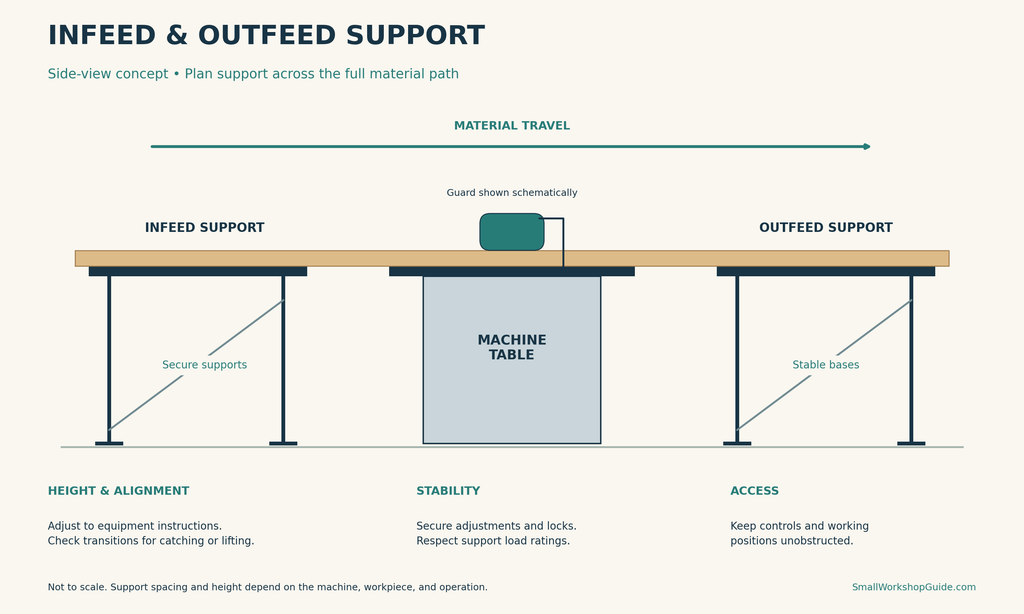
Do not choose a universal support height based on someone else’s workshop.
Measure and adjust the setup in its actual operating position, following the machine and support instructions.
A support that is too high can interfere with the workpiece’s travel or lift it from its intended contact with the machine table. A support that is too low may fail to carry the material when needed.
Avoid assuming that every accessory requires precisely the same height relationship. Follow the specified arrangement for your equipment.
Check the whole support surface
With the equipment disconnected for setup checks, use a suitable straightedge or the manufacturer’s prescribed method to assess alignment.
Check more than one point. A surface may be correctly positioned at one corner and uneven elsewhere.
Also inspect the transition between the machine and support. An edge, gap, obstruction, or height mismatch may catch the material.
Check Stability Before Loading Material
A support should remain stable under the intended load and movement.
Check that:
- Feet or bases sit securely on the floor.
- Folding mechanisms are fully deployed and locked.
- Height adjustments are secured.
- Mobile components are locked or supported as instructed.
- The load stays within the equipment’s rating.
- The arrangement does not depend on loose packing or unstable objects.
A published load capacity does not guarantee stability in every configuration. Position, load distribution, and the manufacturer’s setup requirements still matter.
Recheck after moving the equipment
Garage and shed floors may vary in level.
Moving a saw or stand can change the relationship between the surfaces, even if their adjustments were not touched.
If your support doubles as a mobile bench, include these checks in the setup routine. See our mobile workbench planning guide for related considerations.
Comparing permanent support with a setup you can store between sessions? Take a look at Ultimate Small Shop while developing your workshop plan.
Preserve Clearance for Jigs and Accessories
A support table can interfere with an accessory even when ordinary boards travel across it.
Check the movement of miter-gauge bars, sled runners, sliding attachments, and other equipment you intend to use.
For example, a runner extending beyond the rear of a saw table may strike an outfeed surface unless the setup provides appropriate clearance.
Do not remove required safety equipment or alter a machine to make an incompatible support fit. Use a suitable arrangement and follow the relevant instructions.
Also check access to:
- The power switch.
- Adjustment controls.
- Dust connections.
- Service panels.
- The intended operator position.
Keep Supports Out of Walking Routes
The tabletop may look compact while the legs extend into the aisle.
Draw the full footprint of every stand, including splayed legs, braces, and handles. Add cords and hoses to the operating layout.
A useful arrangement must allow material handling without stepping around support legs or reaching across an obstruction.
If the support blocks an exit or another essential route, revise its position before operating the tool.
Our workbench and assembly-area placement guide can help you coordinate these competing uses.
Different Machines Need Different Support Arrangements
A support that works with one machine may be unsuitable for another.
Table saws
Plan for the complete material path and the support needed as the workpiece moves beyond the table.
Large panels may require a different arrangement from long, narrow boards.
If panels remain difficult to handle despite a suitable support system, reconsider the breakdown method. Our table saw versus track saw comparison explores that choice.
Miter saws
Long stock may extend on both sides of the cutting area. Support must suit the material and the saw’s operating instructions.
DEWALT’s miter saw guidance specifically warns against using another person as a substitute for a table extension or appropriate material support.
For station planning, see our small-shop miter saw station guide.
Planers and jointers
Follow the machine’s requirements for stock dimensions, feed direction, and support.
Do not transfer a table saw’s support arrangement to a planer or jointer without checking suitability. Feed behavior and the relationship between machine surfaces differ.
Our planer and jointer placement guide covers the surrounding space.
Plan Storage Before Buying Supports
Decide where support equipment will go when it is not in use.
Measure its folded or stored footprint as well as its deployed size.
A support that is difficult to retrieve or obstructs another tool can make setup unnecessarily complicated.
Useful storage questions include:
- Can I retrieve it without unloading a shelf?
- Will it remain secure in its stored position?
- Can all required parts stay together?
- Is there space to unfold it fully?
- Will its storage position block access or an exit?
Avoid storing heavy support equipment where retrieving it requires an awkward lift.
Use a Repeatable Setup Check
Before starting an operation:
- Position and secure the machine.
- Deploy the supports according to their instructions.
- Check height, alignment, stability, and capacity.
- Confirm the full material path and accessory travel.
- Clear tools, offcuts, cords, and other obstructions.
- Check access to controls and the operator’s working area.
Perform setup checks with the machine disconnected where instructed. Do not make a powered cut merely to discover whether an uncertain support arrangement works.
If material catches, shifts, or becomes difficult to control during operation, follow the machine’s stopping procedure. Reassess the setup before continuing.
Frequently Asked Questions
Is an outfeed table better than a roller stand?
It depends on the workpiece and operation. A table provides a broader support area, while a roller stand may be easier to store. Both require appropriate setup.
Can I use an ordinary workbench behind my table saw?
Only if its height, stability, surface, position, and compatibility suit the operation. Check accessory travel and keep the surface clear.
Do I always need both infeed and outfeed support?
Support requirements depend on the material and equipment instructions. Assess the entire operation rather than assuming one arrangement suits every cut.
Can a helper replace support equipment?
Do not assume so. Follow the machine’s instructions; some explicitly prohibit using another person as a substitute for the required support.
Can I leave supports set up permanently?
Yes, where the arrangement is suitable and preserves required access. Continue checking condition and alignment rather than assuming the setup remains correct indefinitely.
Make Support Part of the Working Setup
Infeed and outfeed supports belong in the workshop plan alongside the machine.
Choose them around the material you process, verify their setup, and account for storage and access. The useful choice is the one that supports the complete operation reliably in your available space.
Ready to develop your broader workshop arrangement? Explore Ultimate Small Shop here.